Why do U.S. appliance retailers generate so much EPS packaging?
In the United States, appliance retail, e-commerce, and third-party logistics networks are highly developed. Large volumes of appliances move every day from warehouses and distribution centers to retail stores and end customers.
To protect large products from impact, pressure, and damage during transportation, EPS foam packaging is widely used for refrigerators, washing machines, dryers, TVs, kitchen appliances, air conditioners, and other household appliances.
In the U.S., this foam is commonly referred to as Styrofoam. It is lightweight, shock-absorbing, and cost-effective. But once the appliances are unpacked, it quickly becomes a “white burden” inside distribution centers.
What challenges do appliance distribution centers face with EPS packaging?
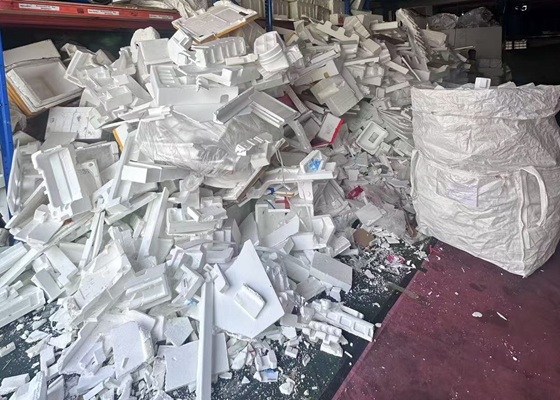
The first challenge is space. EPS packaging takes up a lot of room. Foam corners and protective inserts from just one refrigerator or washing machine can quickly fill packing areas, return zones, storage corners, or loading docks.
The second challenge is hauling cost. Loose EPS is extremely lightweight, but it fills trucks and containers very quickly. In many cases, companies are paying to transport air rather than actual material. Relying on frequent third-party pickups can become a long-term operating expense.
The third challenge is compliance and customer pressure. Across the U.S., packaging waste management requirements are gradually becoming stricter in many states. Appliance retailers, logistics providers, and warehouse operators need to pay closer attention to sorting, recycling, and documentation. For companies serving major brands, retailers, or e-commerce platforms, ESG and sustainable supply chain expectations are also becoming important competitive factors.
How does GREENMAX help companies build an EPS recycling system?
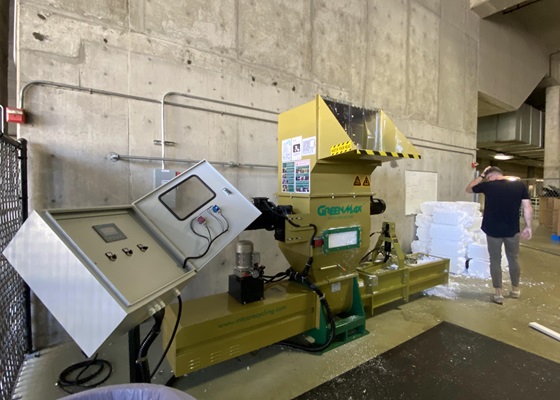
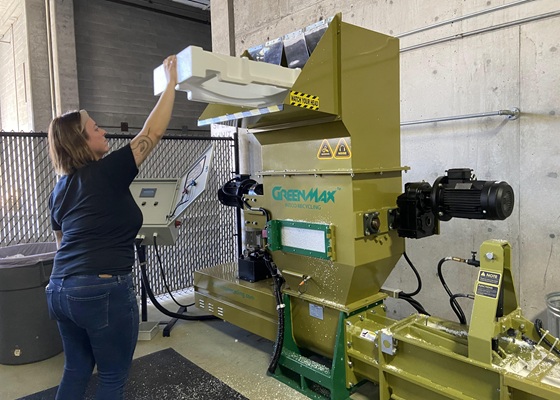
A GREENMAX Styrofoam compactor can be installed directly in appliance warehouses, distribution centers, or after-sales return facilities. Employees simply feed the unpacked EPS foam into the machine. The equipment shreds and screw-compacts the loose foam into high-density EPS blocks.
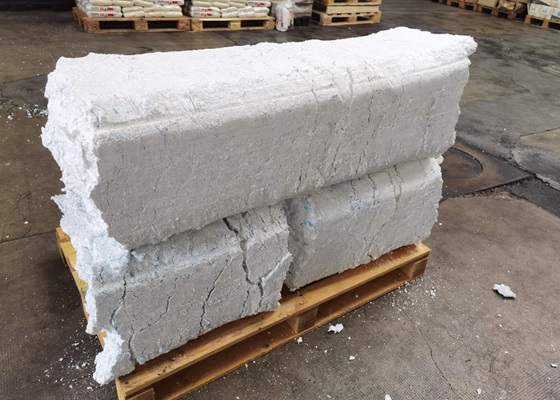
After compaction, the volume of foam is greatly reduced. Warehouses no longer need to store large amounts of loose packaging for long periods. The compacted blocks are easier to stack, pack, transport, and sell to downstream recyclers.
For appliance distribution centers with a steady flow of EPS waste, this means fewer pickups, lower transportation costs, and better use of warehouse space. More importantly, foam that once required paid disposal can become a recyclable material with resale value.
Which companies are best suited for a Styrofoam compactor?
A Styrofoam compactor is especially suitable for appliance retailer distribution centers, e-commerce warehouses, 3PL logistics centers, appliance repair and service centers, return processing facilities, importer warehouses, and large retail stores with backroom storage areas.
If a company handles daily appliance unpacking, return processing, or repackaging, and EPS foam constantly occupies warehouse space, building an internal EPS recycling system is worth serious consideration.
For U.S. appliance retailers and logistics distribution centers, EPS packaging waste is not just trash. It represents hidden space costs, hauling costs, and compliance pressure.
With a GREENMAX Styrofoam compactor, companies can compress loose foam into high-density blocks, reduce volume, improve recycling efficiency, and recover material value.
GREENMAX helps the appliance industry turn white foam packaging from a warehouse burden into a sellable resource.