The export ban changed the pathway
In July 2021, Australia banned the export of unsorted mixed waste plastics. A year later, the ban was extended to unprocessed single-resin material. Both measures sit under the Recycling and Waste Reduction Act 2020.
For recyclers, the effect was not a shift in buying prices. It was a change of route. EPS could no longer be containerised and shipped out loose. Whether polystyrene recycling works as a business now depends less on finding an overseas buyer than on whether processing capacity exists onshore.
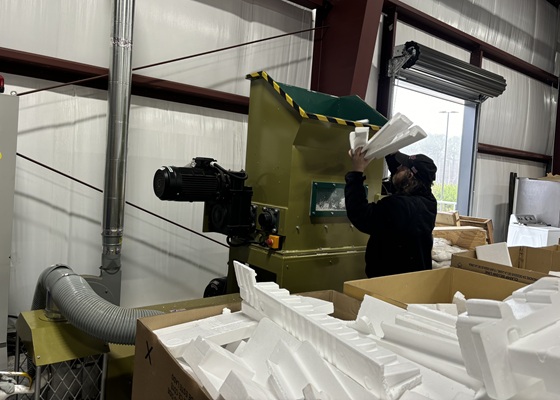
What collection looks like on the ground
EPS is a number 6 plastic, and most municipal kerbside systems will not take it. The material therefore moves almost entirely through commercial channels, and three features shape that flow.
Sources are fragmented. Appliance and electronics packaging, seafood cold-chain boxes, produce crates and building insulation are the main streams. Volumes at any single site are modest; the number of sites is not. Collection alone absorbs a meaningful share of the cost base.
Distances are long. Australian cities sit far apart and interstate freight is expensive, so the radius a collector can economically service is limited. For most yards, processing on site is more workable than consolidating and hauling.
Landfill is getting dearer. Levy rates differ between states, but the direction is broadly the same. Using landfill as a fallback is becoming harder to defend on cost.
Together, these points narrow the question to throughput and destination. Cost follows volume, not weight.
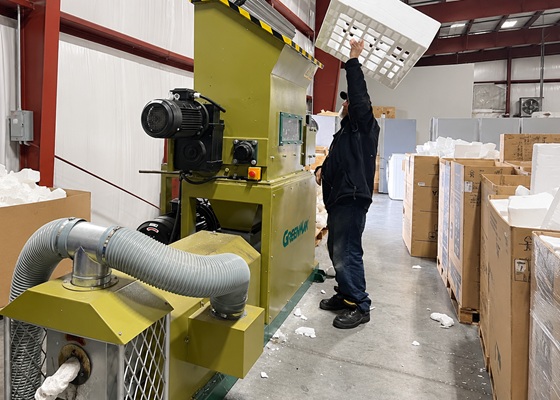
GREENMAX M-C200 Polytyrene Melting Machine
Mars is GREENMAX’s polystyrene melting machine. The M-C200 sits in the middle of the range, rated at around 200 kg/h — enough for a site handling mixed commercial streams, without the footprint and power draw of a larger unit.
Material coverage is broad: EPS, EPS dust, XPS insulation board, PSP food containers and cups, EPE and EPP. For Australian collectors, whose feedstock shifts with the season and the customer mix, that flexibility tends to matter more than a marginal gain in hourly output.
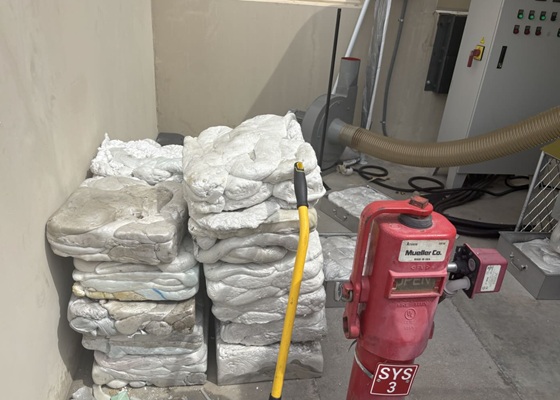
The finished product is a dense ingot. Hot-melt extrusion takes EPS to a compression ratio of roughly 90:1 and an ingot density of 600–800 kg/m³, so the material stores in a fraction of the space taken by loose foam, loads efficiently into containers, and enters the market as feedstock rather than as waste. GREENMAX also buys back hot-melted ingots, which gives operators a comparatively predictable route to market — useful where the baled output of a cold-press EPS compactor is harder to place.
Specifications
| ITEM | M-C100 |
| Motor Power | 22.9 kW / 30.6 hp |
| Production Capacity | 100 kg per hour / 220 lbs per hour |
| EPS Compression Ratio | 90:1 |
| Compressed EPS Density | 600-800 kg/m³ / 1320-1750 lbs/cubic yard |
| Feed Hopper Door | 800*555 (l/w) mm / 31.5*21.9 (l/w) in. |
| Dimensions | 2030*1430*2040 (l/w/h) mm / 79.9*56.3*80.3 (l/w/h) in. |
| Weight | 1,500 kg / 3,300 lbs |
Before you commit
Four figures should be settled before selecting a machine: monthly throughput, available floor area, power capacity, and the intended sales channel for the finished product. The first three determine the model. The fourth determines whether the investment pays back.
The export ban kept Australian EPS onshore. It also made local processing capacity the variable that separates one collector from the next.